Insights · Workplace Wellbeing Series · Part 5
Seven daily practices that protect the working mind
Dr. C. Sreenivasula Reddy · Occupational Health Physician · 25 July 2026 · 4 min read
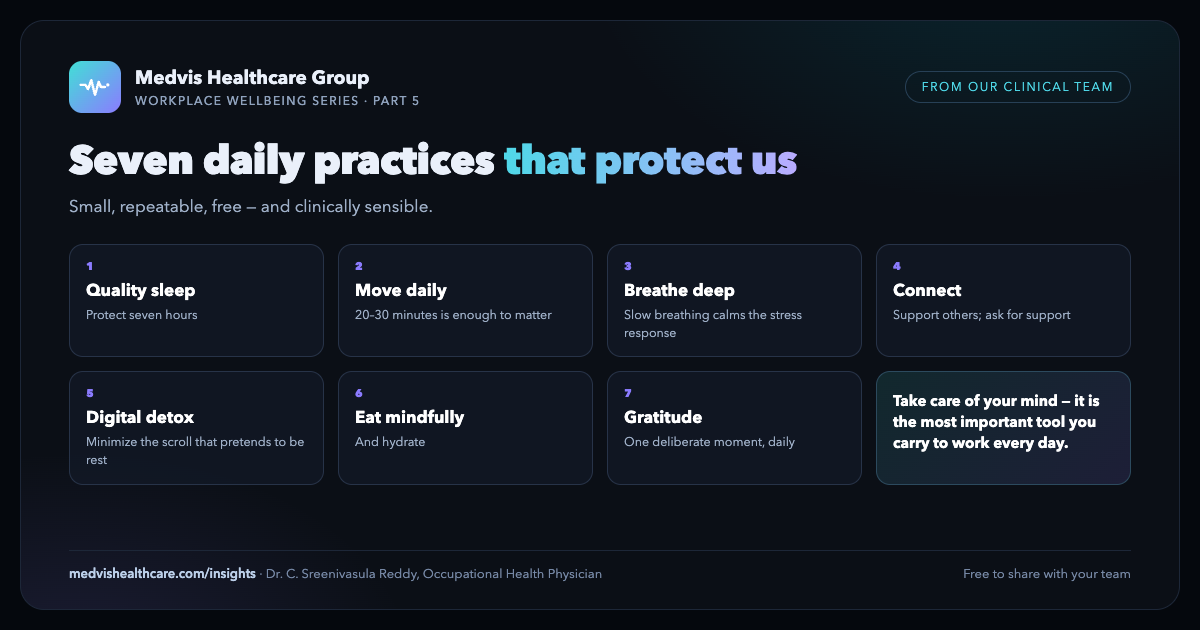
The mental disciplines in this series work on the mind directly. But the mind runs on a body, and the body is protected by small, repeatable practices — none of which cost money, and all of which are routinely sacrificed to a busy week. Here are the seven I ask working people to guard.
1. Quality sleep — protect seven hours
Sleep is not recovery from life; it is a biological requirement for mood, judgment and immunity. Most “stress symptoms” soften remarkably when sleep is repaired first.
2. Move daily — 20 to 30 minutes
Not a fitness program — movement. A brisk walk is enough to shift mood chemistry and discharge the day’s accumulated arousal.
3. Breathe deep
Slow, deep breathing is the one lever on the stress response you can pull anywhere, in seconds, without anyone noticing. A few slow exhales before a difficult conversation changes the conversation.
4. Connect — support others, ask for support
Isolation amplifies every other stressor. A genuine five-minute conversation does more for a strained mind than an hour of scrolling.
5. Digital detox — minimize the scroll
The scroll masquerades as rest while delivering the opposite: comparison, noise and vigilance. Give the mind actual idle time — that is when it files the day away.
6. Eat mindfully and hydrate
Erratic eating and dehydration read to the body as emergencies. Regular meals, eaten with attention, are quiet signals of safety.
7. Gratitude — one deliberate moment, daily
Attention is trainable. One deliberate note of what went right recalibrates a mind that spends all day scanning for what could go wrong.
How to actually keep them
Do not adopt all seven on Monday. Choose one, attach it to an existing habit — breath practice after locking your screen, gratitude with the evening tea — and let it become invisible before adding the next. Small and permanent beats grand and abandoned.
Take care of your mind — it is the most important tool you carry to work every day.
The Workplace Wellbeing Series
- Overview — Stress builds up. Happiness builds within.
- Part 1 — How stress builds up: the four layers
- Part 2 — Nishkama Karma: action without attachment
- Part 3 — Sakshibhava: be the witness
- Part 4 — Buddhi Yoga: wisdom in action
- Part 5 — Seven daily practices that protect us (you are here)
Building a workforce wellbeing program?
Talk to our clinical team about whole-person employee health.
This article is general wellbeing guidance, not medical or psychological treatment. If stress, anxiety or low mood are persistent or interfering with your life, please reach out to a qualified mental-health professional — seeking help early is a strength, not a weakness.