Insights · Workplace Wellbeing Series · Part 1
How stress builds up at work: the four layers
Dr. C. Sreenivasula Reddy · Occupational Health Physician · 25 July 2026 · 4 min read
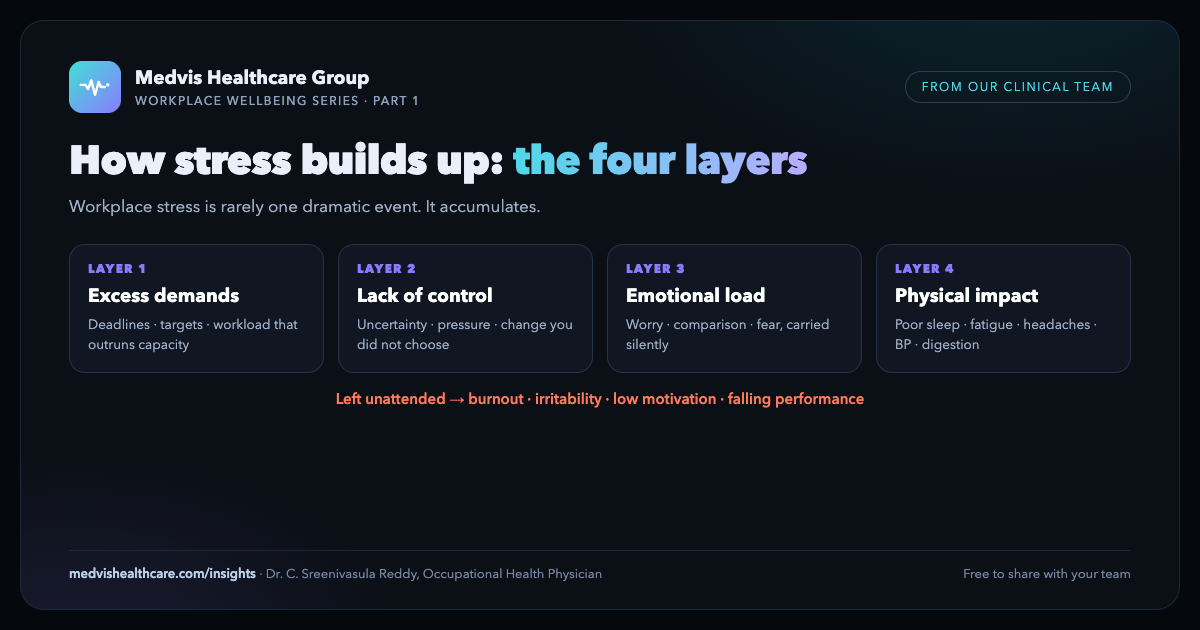
Workplace stress is rarely one dramatic event. In clinic conversations with working people, the same pattern repeats: stress accumulates quietly, layer upon layer, until the body starts reporting what the mind has been absorbing. Understanding the four layers is the first step to interrupting them.
Layer 1 — Excess demands
Deadlines, targets, workload that outruns capacity. Demands are not the enemy — meaningful work needs them. The trouble begins when demand runs persistently ahead of capacity and recovery, so every week starts in deficit.
Layer 2 — Lack of control
Uncertainty, pressure, change you did not choose. Decades of occupational research agree on this point: high demands are far more damaging when paired with low control. The same workload feels entirely different when you have a say in how it is done.
Layer 3 — Emotional load
Worry about performance, comparison with peers, fear of what a review or a restructure might bring. This layer is carried silently — it does not appear on any workload chart, which is exactly why it compounds.
Layer 4 — Physical impact
The body keeps the score of what the mind absorbs: disturbed sleep, fatigue that rest does not fix, headaches, rising blood pressure, digestive trouble. By the time stress is visible as a physical symptom, it has usually been building for months.
The tightening cycle
Left unattended, the four layers feed each other: poor sleep reduces capacity, reduced capacity makes demands feel heavier, heavier demands raise the emotional load — and the cycle tightens into burnout, irritability, low motivation and falling performance. The person is then blamed for the performance, which adds another turn of the screw.
Our needs have a structure — food, sleep and breath at the base; safety and stability above them; then belonging, esteem, and finally meaning and growth. Stress attacks this structure from the bottom. That is why the protective work starts with sleep, movement and breath — not with motivational posters.
Stress is not a personal failure. It is an accumulation — and accumulations can be interrupted.
In the rest of this series, I cover three mental disciplines from our own tradition that interrupt the cycle at the level of the mind, and seven daily practices that protect it at the level of the body.
The Workplace Wellbeing Series
- Overview — Stress builds up. Happiness builds within.
- Part 1 — How stress builds up: the four layers (you are here)
- Part 2 — Nishkama Karma: action without attachment
- Part 3 — Sakshibhava: be the witness
- Part 4 — Buddhi Yoga: wisdom in action
- Part 5 — Seven daily practices that protect us
Building a workforce wellbeing program?
Talk to our clinical team about whole-person employee health.
This article is general wellbeing guidance, not medical or psychological treatment. If stress, anxiety or low mood are persistent or interfering with your life, please reach out to a qualified mental-health professional — seeking help early is a strength, not a weakness.