Insights · Workplace Wellbeing Series · Part 3
Sakshibhava: the witness stance
Dr. C. Sreenivasula Reddy · Occupational Health Physician · 25 July 2026 · 4 min read
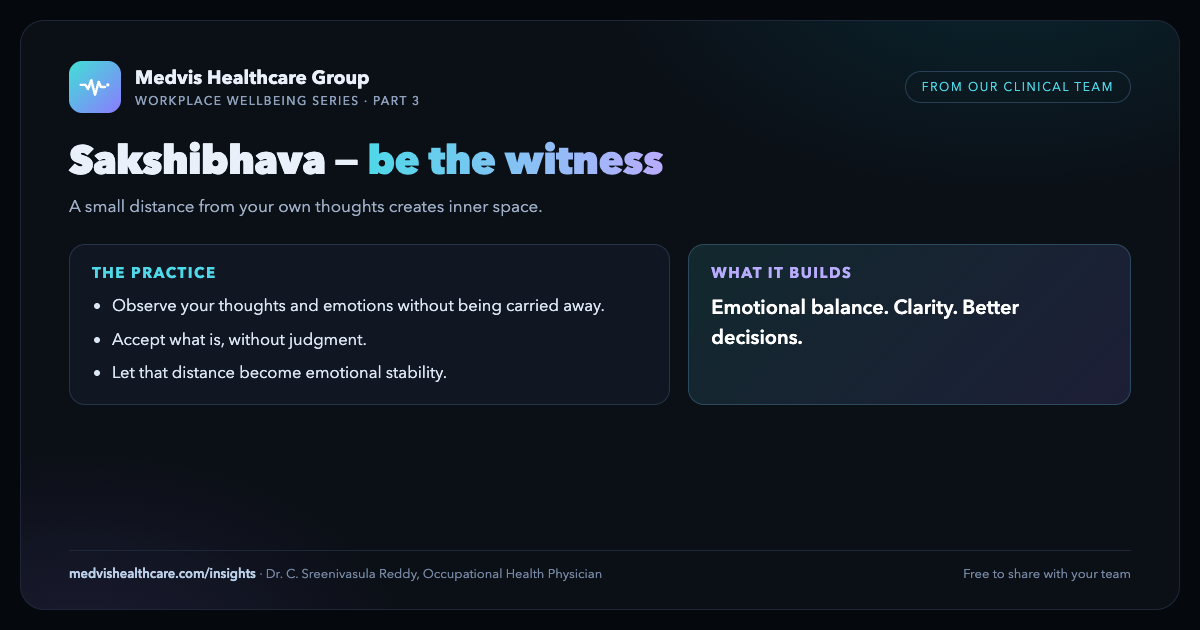
Sakshibhava — literally, the attitude of the witness — is the discipline of observing your own thoughts and emotions without being swept away by them. Modern psychology would recognize the idea instantly: the ability to notice a thought as a thought, rather than obeying it as a command, is central to several contemporary approaches to mental wellbeing.
The problem it solves
At work, the trouble is rarely the first thought — the flash of anger at an email, the spike of worry before a review. The trouble is the chain that follows: the rehearsed argument, the catastrophic forecast, the hour of rumination. We do not choose the first thought. We do participate in the chain.
The practice
- Observe without being carried away. When a strong emotion rises, name it silently — “worry is here”, “anger is here”. Naming creates the first inch of distance.
- Accept what is, without judgment. Not approval — acknowledgment. What you refuse to acknowledge, you cannot respond to wisely.
- Let the distance become stability. In that inch of space lives the choice you did not have a moment earlier: respond, or react.
Micro-practices for a working day
Before opening a difficult email, one breath: “let me read this as a witness.” In a heated meeting, feel your feet on the floor and watch the urge to interrupt rise and pass. After a setback, give the disappointment a name before giving it a story. None of this takes time; it takes remembering.
You are not the storm. You are the one watching the weather — and the watcher can choose the response.
What it builds: emotional balance, clarity, better decisions — the exact qualities a pressured workplace drains first.
The Workplace Wellbeing Series
Building a workforce wellbeing program?
Talk to our clinical team about whole-person employee health.
This article is general wellbeing guidance, not medical or psychological treatment. If stress, anxiety or low mood are persistent or interfering with your life, please reach out to a qualified mental-health professional — seeking help early is a strength, not a weakness.